Matt Keegan’s second solo exhibition at D’Amelio Terras is in the gallery’s Project Room, and though it is a smaller space, this show is simultaneously less dense and more compressed than his previous exhibition in the fall of 2007. Both these adjectives indicate a growing assuredness in the artist’s ability to focus his method of constructing a dislocated and slightly fugitive aesthetic experience.
If Keegan’s first show, “Any Day Now,” was impressive for finely articulating an emotional presence in all of the excised spaces in the works, it was also a bit over-extended. “New Windows” finds many of the same techniques, both within and between the works, but with a touch that easily prevents absence from becoming a vacuum. The title of the show is taken from an eponymous series of six photo-collages, all taken during the installation of new windows in his apartment. They show an anonymous Mr. Fix-It hunched down on the floor, all plaid shirt and work boots in so many misshapen lumps. But more importantly, each collage is made of several different shots of the scene, cut and layered together to create surprising and delightful impossibilities. Their title, “New Windows,” is direct and literal, and yet it is subsumed into pure metaphor by the spatial inventiveness and material sensitivity that courses through these six pieces.

It is this action that activates Keegan’s work: the direct and literal subsumed by metaphor. It is this transformation that allows actions to become gestures, and that allows those gestures to carry a broad range of psychological and emotional associations. In this respect the work is very generous, granting the viewer both the benefit of the doubt and the freedom to operate within the conceptual space of the exhibition.
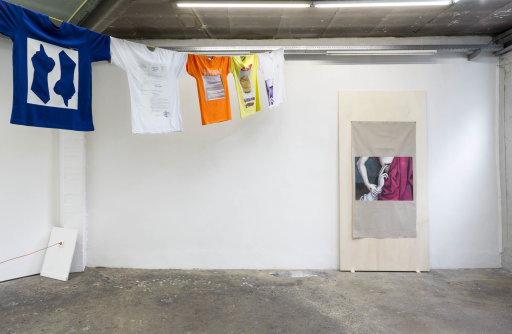
And this show is about the constructing of that conceptual space. The freestanding metal-stud and sheetrock piece, with its inscriptions on one side and photographic enlargement on the other, captures the play of contradictions at work here. As a wall section, the piece “cuts” into the Project Room, obscuring the space from outside the door (in a gesture quite unlike a window); as a text work excised from the surface, the work obscures as it narrates a concise emotional passage from slightly-paranoid to erotically-heightened to flatly-acquisitive; as a photographic image on the verso, it reads as a culmination of Mr. Fix-It’s labors, presenting the living room all re-assembled with its new windows. And yet the de-saturated emotional timbre feels something like, “new windows, same as the old windows.”
While this sentiment is rewarding within Keegan’s work, it also applies to a less-rewarding degree to the lone work of Richard Aldrich’s which Keegan has placed in the gallery. A classic stretcher-stripped-nearly-bare-of-its-canvas, the attractive physicality of this work is never supplemented by the emotional register that Keegan otherwise injects into his own objects. To prove the point, one need only look to the right, where “Untitled (Light Leak)”, a photographic print “revealed” but cutting concentric ovals through three sheets of drywall, pierces the gallery with a lone note of lush green and sunlight. When one considers that this highly constructed photo-work *merely depicts* a leak through a wall that was built for the occasion, and which obscures the gallery windows, the irony and absurdity join forces. They suggest that the idea of a single ray of glistening light is more important than a whole glass wall full of the real thing.
My notion about a more compressed exhibition, then, is a remark about the feeling of these works tightly cohering into a meditation on how the coordinates of a room are transformed into a “space,” as it is imbued with memories and preferences by those dwelling within it. (I suppose this is the role of the cat picture, which otherwise leaves me unmoved. But then again I’m allergic to cats. The personal is political!) Keegan manages this cohesion even as he leaves the space less dense with objects. One senses the artist beginning with a mundane event from his immediate, personal experience and, with focus and delicacy, reflecting its consequences in multiple directions. The result is a charged, and charming, exhibition.
Post a Comment